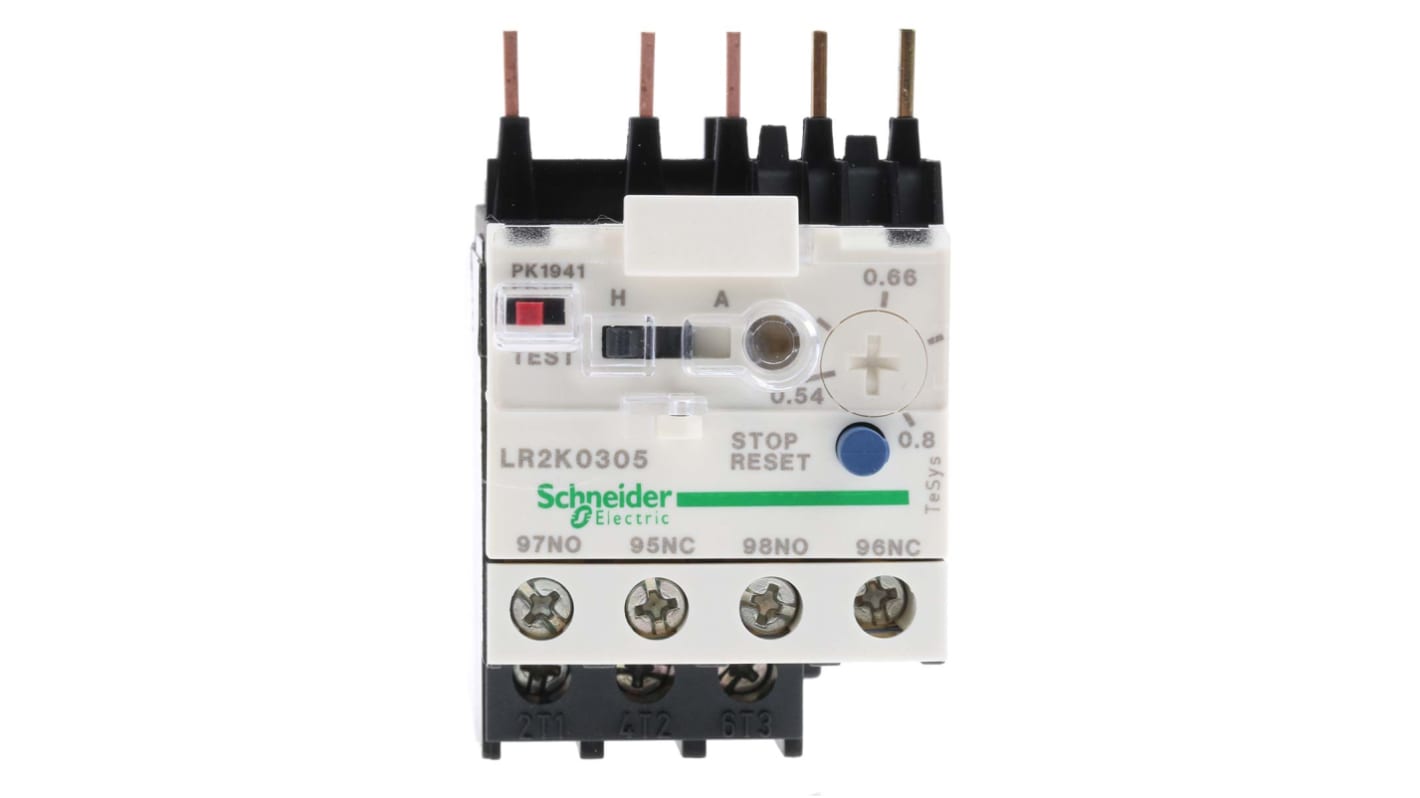
Schneider Electric TeSyS LR Thermal Overload Relay 1NO + 1NC, 0.54 → 0.8 A F.L.C, 10 A Contact Rating, 100 W,
- RS-artikelnummer:
- 758-923
- Distrelec artikelnummer:
- 304-09-056
- Tillv. art.nr:
- LR2K0305
- Tillverkare / varumärke:
- Schneider Electric

Antal (1 enhet)*
754,54 kr
(exkl. moms)
943,18 kr
(inkl. moms)
GRATIS leverans för online beställningar över 500,00 kr
I lager
- 28 enhet(er) är redo att levereras
- Plus 4 enhet(er) är redo att levereras från en annan plats
- Dessutom levereras 18 enhet(er) från den 13 februari 2026
Behöver du mer? Ange den kvantitet du behöver och klicka på "Kontrollera leveransdatum"
Enheter | Per enhet |
|---|---|
| 1 + | 754,54 kr |
*vägledande pris
- RS-artikelnummer:
- 758-923
- Distrelec artikelnummer:
- 304-09-056
- Tillv. art.nr:
- LR2K0305
- Tillverkare / varumärke:
- Schneider Electric
Specifikationer
Datablad
Lagstiftning och ursprungsland
Produktdetaljer
Hitta liknande produkter genom att välja ett eller flera attribut.
Välj alla | Attribut | Värde |
|---|---|---|
| Brand | Schneider Electric | |
| FLC Motor Rating | 0.54 → 0.8 A | |
| Contact Current Rating | 10 A | |
| Range | TeSys | |
| Pole Configuration | 3P | |
| Series | TeSyS LR | |
| Mounting Style | Direct Contactor | |
| Power Rating | 100 W | |
| Normal State Configuration | 1NO + 1NC | |
| Terminal Type | Screw | |
| Reset Method | Automatic, Manual | |
| Number Of Auxiliary Contacts | 2 | |
| Width | 45mm | |
| Depth | 65mm | |
| Length | 116mm | |
| Maximum Operating Temperature | +55°C | |
| Minimum Operating Temperature | -20°C | |
| Operating Temperature Range | -20 → +55 °C | |
| Contact Voltage Rating | 690 V ac | |
| Control Voltage | 250 V dc, 690 V ac | |
| Välj alla | ||
|---|---|---|
Brand Schneider Electric | ||
FLC Motor Rating 0.54 → 0.8 A | ||
Contact Current Rating 10 A | ||
Range TeSys | ||
Pole Configuration 3P | ||
Series TeSyS LR | ||
Mounting Style Direct Contactor | ||
Power Rating 100 W | ||
Normal State Configuration 1NO + 1NC | ||
Terminal Type Screw | ||
Reset Method Automatic, Manual | ||
Number Of Auxiliary Contacts 2 | ||
Width 45mm | ||
Depth 65mm | ||
Length 116mm | ||
Maximum Operating Temperature +55°C | ||
Minimum Operating Temperature -20°C | ||
Operating Temperature Range -20 → +55 °C | ||
Contact Voltage Rating 690 V ac | ||
Control Voltage 250 V dc, 690 V ac | ||
RoHS-status: Undantagen
Schneider Electric Mini Thermal Overload Relays - LR2-K Range
Schneider Electrics K thermal overload relays are adjustable from 0.11 to 11.5 A, they have been predominantly designed for use in applications that require motor protection.
This range of mini thermal overload relays feature compensated and phase failure sensitivity, the range also offers manual and automatic reset. Each overload relay has 3-poles and screw clamp terminals.
This range of mini thermal overload relays feature compensated and phase failure sensitivity, the range also offers manual and automatic reset. Each overload relay has 3-poles and screw clamp terminals.
Features & Benefits
• Commonly referred to by the range short name - LR2K
• Easy maintenance checks, check the tightening of cables through conducting thermographic testing and checking the mechanical operation of the product through manually operating the test, reset and stop buttons
• Direct mounting under a contactor is achievable
• Standards - IEC 947, BS4941, VDE 0660, NFC63-650
• Standards - CSA, UL, DEMKO, NEMKO, SEMKO, FIMKO, PTB
• Easy maintenance checks, check the tightening of cables through conducting thermographic testing and checking the mechanical operation of the product through manually operating the test, reset and stop buttons
• Direct mounting under a contactor is achievable
• Standards - IEC 947, BS4941, VDE 0660, NFC63-650
• Standards - CSA, UL, DEMKO, NEMKO, SEMKO, FIMKO, PTB
Applications of a Contactor and Control Overload Relay
• The majority of the time is to protect a motor
• To detect both overload conditions and fault conditions to then announce trip command for a protective device
• To deactivate a device whenever it pulls high current
• Sometimes developed into microprocessor systems and solid-state electronics
• To detect both overload conditions and fault conditions to then announce trip command for a protective device
• To deactivate a device whenever it pulls high current
• Sometimes developed into microprocessor systems and solid-state electronics