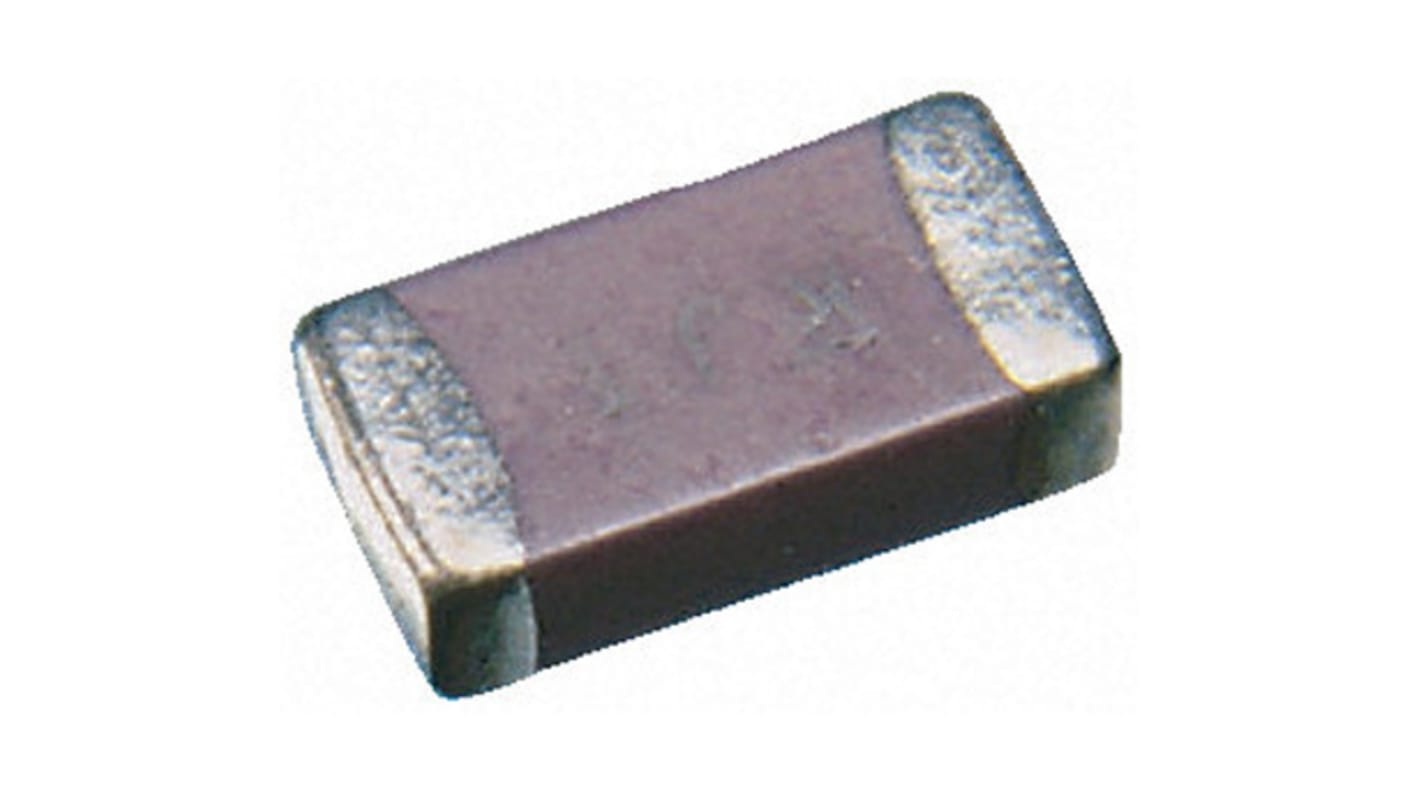
KEMET 100nF Multilayer Ceramic Capacitor MLCC, 25V dc V, ±10% , SMD
- RS-artikelnummer:
- 648-0979P
- Tillv. art.nr:
- C0805C104K3RACTU
- Tillverkare / varumärke:
- KEMET

Antal 10 enheter (levereras på en kontinuerlig remsa)*
4,82 kr
(exkl. moms)
6,02 kr
(inkl. moms)
GRATIS leverans för online beställningar över 500,00 kr
Sista RS lager
- Slutlig(a) 52 490 enhet(er), redo att levereras
Enheter | Per enhet |
|---|---|
| 10 + | 0,482 kr |
*vägledande pris
- RS-artikelnummer:
- 648-0979P
- Tillv. art.nr:
- C0805C104K3RACTU
- Tillverkare / varumärke:
- KEMET
Specifikationer
Datablad
Lagstiftning och ursprungsland
Produktdetaljer
Hitta liknande produkter genom att välja ett eller flera attribut.
Välj alla | Attribut | Värde |
|---|---|---|
| Brand | KEMET | |
| Capacitance | 100nF | |
| Voltage | 25V dc | |
| Package/Case | 0805 (2012M) | |
| Mounting Type | Surface Mount | |
| Dielectric | X7R | |
| Tolerance | ±10% | |
| Dimensions | 2 x 1.25 x 0.9mm | |
| Length | 2mm | |
| Depth | 1.25mm | |
| Height | 0.9mm | |
| Series | C | |
| Maximum Operating Temperature | +125°C | |
| Minimum Operating Temperature | -55°C | |
| Välj alla | ||
|---|---|---|
Brand KEMET | ||
Capacitance 100nF | ||
Voltage 25V dc | ||
Package/Case 0805 (2012M) | ||
Mounting Type Surface Mount | ||
Dielectric X7R | ||
Tolerance ±10% | ||
Dimensions 2 x 1.25 x 0.9mm | ||
Length 2mm | ||
Depth 1.25mm | ||
Height 0.9mm | ||
Series C | ||
Maximum Operating Temperature +125°C | ||
Minimum Operating Temperature -55°C | ||
- COO (Country of Origin):
- CN
Kemet 0805 Automotive Grade SMT MLCC Ceramic Capacitors
0805 size AEC–Q200 automotive qualified SMT MLCC ceramic capacitors with a robust design suitable for harsh environments. These automotive grade SMT MLCC ceramic capacitors have a C0G dielectric with an operating temperature range of -55 to +125°C and offer a high thermal stability, a high ripple current capability and an extremely low ESR and ESL. Typical applications for these automotive grade SMT MLCC capacitors include in-cabin or under-hood mission and safety critical automotive circuits such as critical timing, tuning, circuits requiring low loss, circuits with pulse, high current, decoupling, bypass, filtering, transient voltage suppression, blocking and energy storage.
Approvals
AEC–Q200 automotive qualified
0805 Range
Nickel barrier terminations covered with a layer of plated Tin (NiSn). Applications include mobile phones, video and tuner designs, COG/NPO is the most popular formulation of the "temperature compensating", EIA Class I ceramic materials, X7R, X5R formulations are called "temperature stable" ceramics and fall into the EIA Class II materials, Y5V, Z5U formulations are for general purpose use in a limited temperature range, EIA Class II materials; these characteristics are ideal for decoupling applications.